Guide
·September 25, 2026
How to Build Your BJJ A-Game: Focus on One Position at a Time
Monday is a scissor sweep. Wednesday is a knee slice. Friday is an armbar from mount. Six months in, you've seen dozens of techniques and can't hit any of them in a live roll. The fix isn't learning more. It's picking one position and staying there for weeks.
Why You Keep Forgetting What You Learn in Class
Most gyms rotate through a curriculum, or teach whatever the coach has been playing with that week. That's great for exposure. You see a bit of everything. But exposure isn't the same as learning.
To actually own a technique, you need to drill it, try it on someone resisting, fail, adjust, and try again. That takes weeks, not one class. When the next class moves on to something new, the last technique never gets consolidated. It fades before you've had a chance to hit it even once.
The result is the classic white belt experience: a head full of half-remembered moves, and a live game that's mostly survival.
Why Going Deep on One Position Works
When you spend weeks on a single position, three things happen that don't happen when you sample everything:
- You get the reps. Instead of trying a sweep once and moving on, you attempt it in every roll. Dozens of attempts against different body types and reactions is what moves a technique from “I've seen it” to “I can do it.”
- You understand why it works. The first week you're copying steps. By week four you understand what the grips are actually controlling, why your hips need to be at an angle, and what breaks when your partner posts. That understanding is what lets you adapt when a roll doesn't go to plan.
- You start seeing it everywhere. Once you're focused on half guard, you notice it in every class, every roll you watch, and every match you see online. Details you would have ignored start to stand out.
Depth Is Where the Connections Form
The biggest payoff is that techniques stop being a list and start becoming a system.
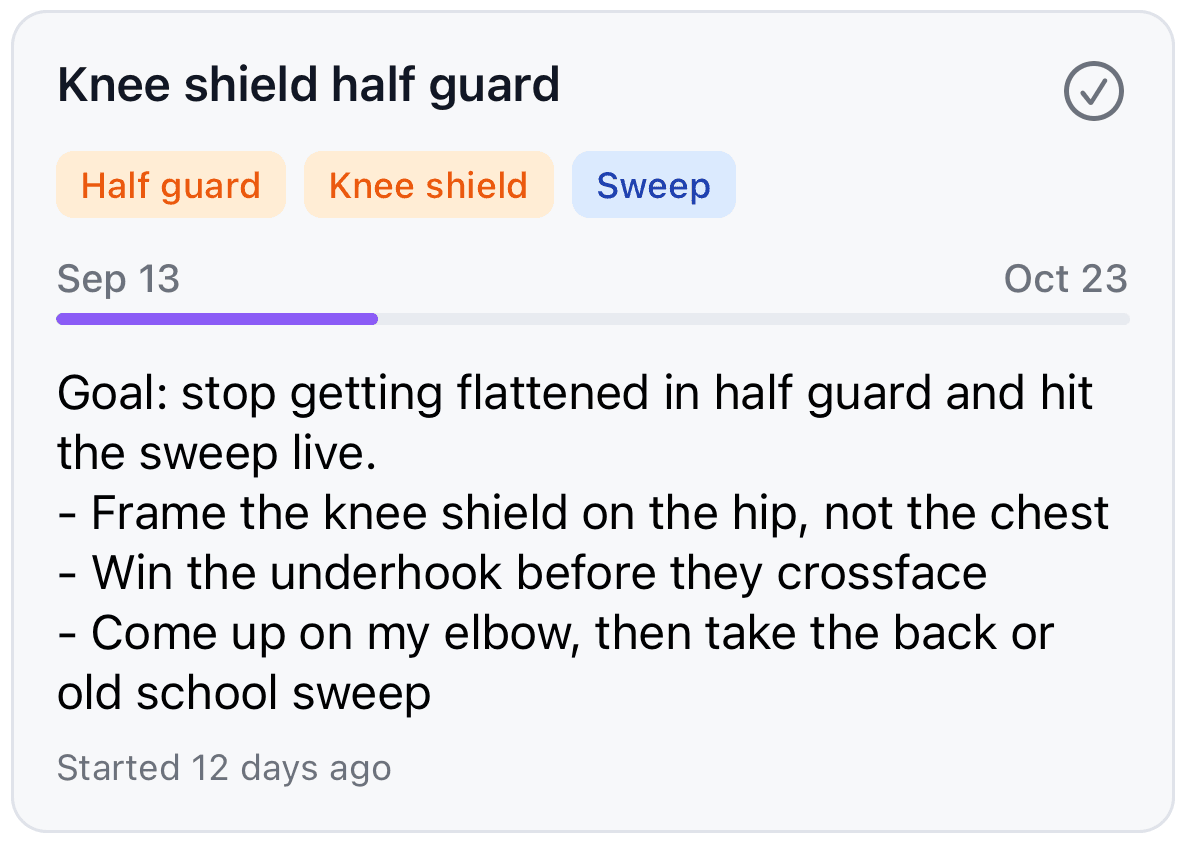
Take knee shield half guard. At first it's just a way to stop getting smashed. After a few weeks you notice that when your partner pushes into the knee shield, it opens the underhook. When you get the underhook, you can come up on your elbow. From there they either sit back and give you the old school sweep, or they sprawl and give you the back.
None of that shows up in a single class. It only appears after enough time in one place to see how the pieces react to each other. That web of if-this-then-that is what people mean when they talk about an “A-game.”
How to Pick Your Focus
The best focus is one that solves a problem you already have. A few good places to look:
- Your recurring problems. If your notes say “got passed from half guard” three weeks in a row, that's your focus. (If you don't keep notes yet, start with our guide on what to write after every BJJ class.)
- Where you spend the most time. If you always end up on the bottom of side control, getting better there will change more rolls than learning a flashy submission you'll rarely set up.
- Defence first if you're new. For white belts, escapes and guard retention pay off fastest. It's hard to work your offence while you're constantly pinned.
Whatever you choose, keep it narrow. “Guard” is too broad to make progress on. “Knee shield half guard” or “escaping mount” is about right: one position, with a handful of techniques that live there.
How Long Should a Focus Last?
Four to six weeks works well for most people training two to four times a week. Less than two weeks usually isn't enough to get through the awkward phase. That's the stretch where you're trying the technique, getting stuffed, and wondering if you're wasting your time.
A rough progression looks like this: the first couple of weeks you're clumsy and it rarely works. Then it starts landing on newer training partners. By the end, you're hitting it on people at your level, or at least getting close enough to know exactly what's going wrong.
How to Run a Focus Block
Picking a focus is the easy part. Here's how to actually stick with it:
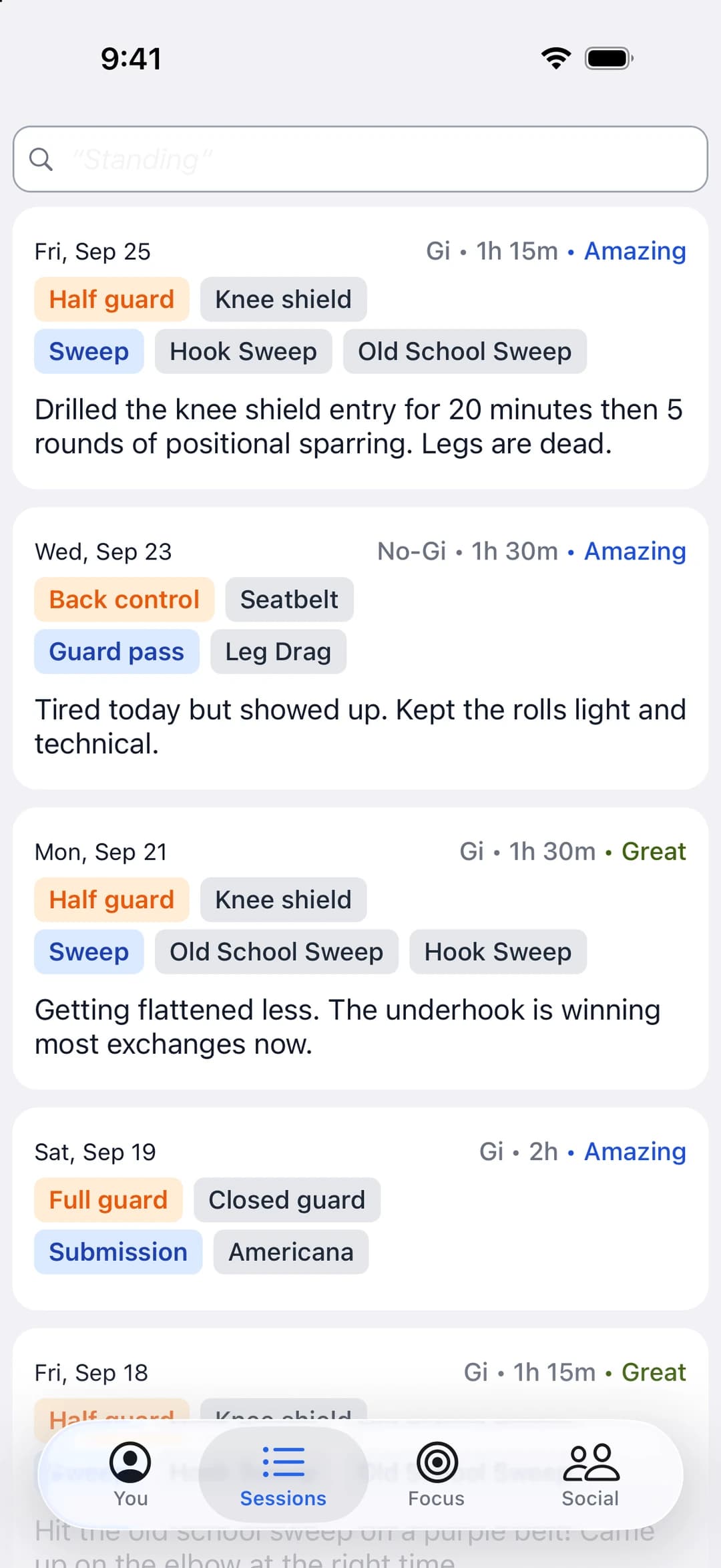
- Write down what you're working on. The position, the few techniques you want to hit, and the key details you keep forgetting. This becomes your pre-class reminder.
- Steer your rolls there. If your focus is half guard, pull half guard or work your way into it, even if it costs you the round. You're not trying to win the roll; you're trying to get reps.
- Ask for positional sparring. Most training partners are happy to start from a specific position. Five rounds starting in half guard will give you more reps than a week of regular rolling.
- Study only that position. Watch instructionals and matches for your focus, and ignore everything else for now. It'll still be there next block.
- Log every session. Note whether the position came up, what worked and what didn't. It's the only way to know if you're actually making progress or just feel like you are.
What If Class Teaches Something Else?
It will, most weeks. That's fine. Class is not a private lesson, and you should still drill what your coach is teaching. Two things help:
- Look for the link. Even an unrelated technique often connects to your focus somehow. A closed guard class still teaches grips, angles, and off-balancing that carry over to half guard.
- Use rolling and open mat for your focus. Drilling time belongs to the coach. Live rounds and open mats are where you work your own project.
A Focus Takes the Guesswork Out of Training
There's a less obvious benefit to having a set focus: you stop deciding what to work on every time you step on the mat.
Without one, every roll starts with a small decision. Should I work my guard? Try that new pass? Just survive? Most of the time you default to whatever you already know, and nothing new gets built. With a focus, the decision is already made. You walk in knowing what you're there to do.
The simplest habit that makes this work: reread your focus notes before class. Two minutes in the car park is enough to remind yourself of the details you wrote down last week, so you go into rolling with them fresh in your mind.
Ending a Block and Picking the Next One
When the block is up, take five minutes to look back before moving on:
- Are you getting to the position without having to force it?
- Can you hit at least one technique from there on people at your level?
- What still breaks down, and why?
If the answer to the first two is still no, it's fine to run it again. If it's yes, write a short summary of what you learned and pick the next focus.
The best next focus usually connects to the last one. If you've been working half guard sweeps, the next natural step might be what happens after the sweep lands, or passing half guard from the top. Each block builds on the previous one, and after a year you don't have a pile of disconnected moves. You have a game.
Example: A White Belt's First Year
Here's what a year of focus blocks might look like for a newer white belt. Notice how each one leads into the next.
| Block | Focus | Why it's next |
|---|---|---|
| Weeks 1–6 | Escaping side control | It's where newer people spend most of their rolls |
| Weeks 7–12 | Escaping mount | Same frames and hip escapes, the next pin up |
| Weeks 13–18 | Half guard retention | Escapes often land you in half guard; now keep it |
| Weeks 19–24 | Knee shield sweeps | Turn a defensive half guard into offence |
| Weeks 25–30 | Passing half guard | The other side of the position you now know well |
| Weeks 31–36 | Side control top | Where you end up after the pass |
| Weeks 37–42 | Kimura from side control | A first submission from a position you can hold |
| Weeks 43–52 | Back takes and back control | Connects half guard, side control and the kimura |
Your year will look different, and it should. Let the problems in your own rolls decide what comes next. The point is the pattern: one thing at a time, each one connected to the last.
Common Mistakes
- Picking something too broad. “Get better at guard” is a wish, not a focus. Narrow it down to a single position.
- Quitting in the awkward phase. Getting stuffed for the first two weeks is normal. That's the learning, not a sign it isn't working.
- Only drilling, never rolling. A technique you've never tried on a resisting partner isn't really part of your game yet.
- Forgetting you have a focus. Without writing it down and reviewing it, it's easy to drift back to your old habits by week two.
Set Your First Focus with GrappleDex
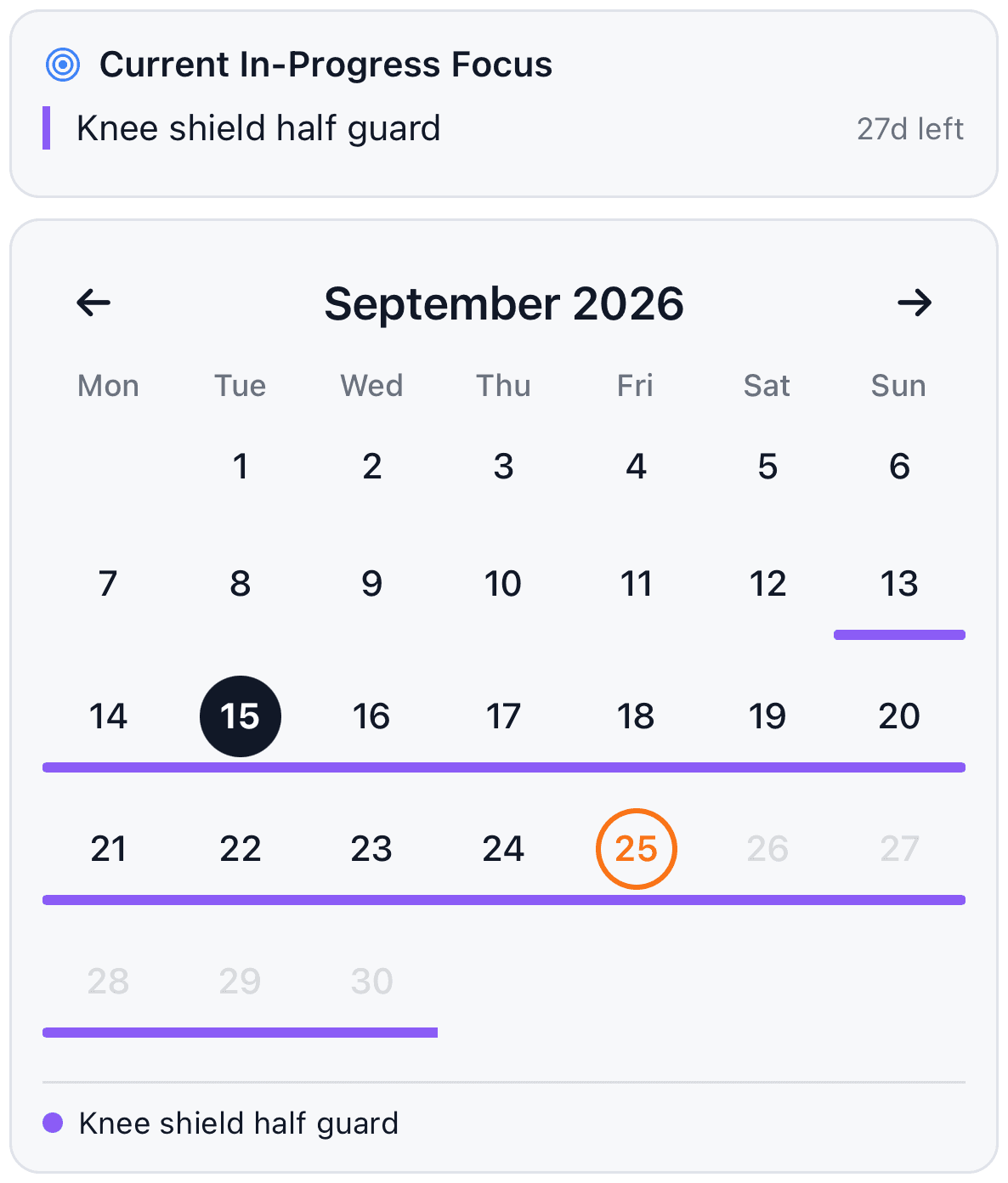
Create a focus with the positions and techniques you're working on, keep your notes in one place to review before class, and see it on your calendar until the block is done. Your weekly summary tells you whether your sessions actually worked on it.